
Illuminance is a measure of how much luminous flux is spread over a given area. Illuminance is measured with optical device called lux meter. Luminous flux (measured in lumens) is a measure of the total amount of visible light present. The illuminance is a measure of the intensity of illumination on a surface. A given amount of light will illuminate a surface darker if it is spread over a larger area, so illuminance is inversely proportional to area.
One lux is equal to one lumen per square meter: 1 lx = 1 lm/m2
Because LED lights have much higher luminous flux than other light sources, we can achieve higher illumination with LED lights than other light sources.
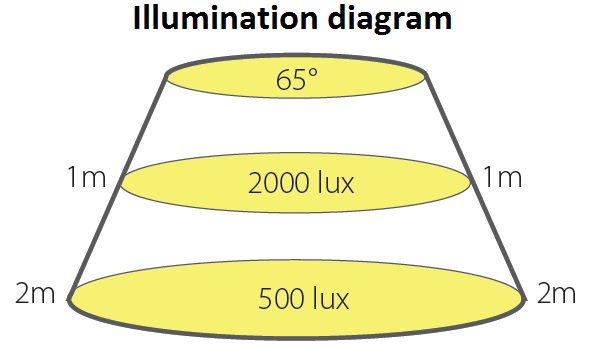
A flux of 1,000 lumens, concentrated into an area of one square meter, lights up that square meter with an illuminance of 1,000 lux. However, the same 1,000 lumens, spread out over ten square metres, produce a darker illuminance of only 100 lux. If we put the light higher we can illuminate the wider area, but the level of illumination will be lower. We can show this relationship with illumination diagram.
For better imagining of Illumination in lux we can compare the illumination of natural lights sources measured in lux.
| Surfaces illuminated by: | Illuminance[lx] |
| Full moon on a clear night | 0,27 |
| Twilight under a clear sky | 3,4 |
| Sunrise or sunset on a clear day | 400 |
| Overcast day | 1.000 |
| Full daylight (not direct sun) | 10.000 – 25.0000 |
| Direct sunlight | 32.000 – 130.0000 |
For different task different levels of illumination are prescribed. It is important that we have enough illumination when we are performing different tasks.
| Activity: | Illuminance[lx] |
| Warehouses, homes, theaters, archives | 150 |
| Easy office work, classes | 250 |
| Normal office work, PC work, study library, groceries, show room, laboratories | 500 |
| Supermarkets, mechanical workshop, office landscape | 750 |
| Normal drawing work, detailed mechanical workshop, operation theatres | 1000 |
| Detailed drawing work, very detailed mechanical works | 1500 – 2000 |